
The Anatomy of Facial Collapse: Why Teeth Get Shorter
Natural wear and tear is an inevitable aspect of aging. Decades of chewing, acid erosion, and involuntary nocturnal clenching or grinding (bruxism) gradually erode dental enamel.
Micro-Attrition: The edges of front incisors chip and flatten, reducing their overall vertical length.
Loss of Occlusal Vertical Dimension (OVD): Back molars act as the structural pillars of the lower face. As grinding flattens posterior teeth, the physical distance between the tip of the nose and the base of the chin decreases
The Anatomy of Facial Collapse: Why Teeth Get ShorterHow Tooth Length Rebuilds Facial Volume and Lip Support
Teeth act as a natural structural frame for the lips and lower third of the face. Rebuilding tooth length restores support in two primary ways:
1. Horizontal Support (Lip Projection and Fullness)
The labial (outer) surface and length of the upper front teeth support the upper lip. Restoring appropriate length and outward volume brings the lip forward into a more natural posture. This reduces fine perioral lines (“smoker’s lines”) by gently stretching the overlying skin without requiring synthetic volume injectionsTeeth act as a natural structural frame for the lips and lower third of the face. Rebuilding tooth length restores support in two primary ways:
2. Vertical Support (Restoring Lower Facial Height)
Increasing the height of the back and front teeth opens the bite back to its ideal biological baseline. Extending the distance between the upper and lower jaws lengthens the lower third of the face. This tightens lax skin around the jawline, softens deep nasolabial folds, and alleviates the compressed appearance around the chin.
| Aesthetic Feature | Effect of Tooth Wear | Effect of Dental Restoration |
| Upper Lip Appearance | Thin, rolled inward, lack of red border display | Fuller, naturally projected, greater lip display |
| Lower Face Height | Compressed, shortened distance from nose to chin | Lengthened profile, restored facial proportions |
| Perioral Wrinkles | Deepened marionette lines and vertical lip creases | Smoothed wrinkles due to renewed underlying tension |
| Jawline & Chin | Sagging skin, over-closed bite (“bulldog” appearance) | Defined jawline with proper structural alignment |
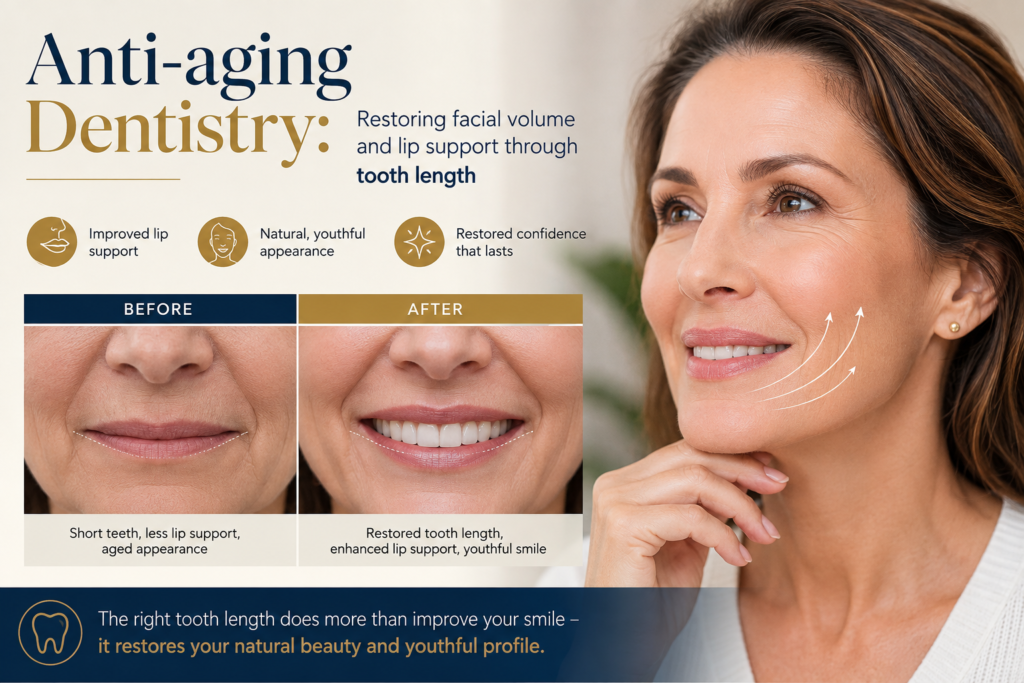
Here Clinical Modalities: Restoring Tooth Structure
Porcelain Veneers & Onlays: Custom ceramic additions can be bonded to worn enamel. Veneers extend the length of front teeth, while onlays rebuild the chewing surfaces of back teeth to open the bite safely.
Full-Mouth Reconstruction: When wear is severe across all quadrants, full-coverage crowns or non-invasive ceramic overlays are placed on all teeth to re-establish a stable, harmonious bite.
Composite Bonding: Resin material can be added directly to worn edges for localized tooth lengthening.
Digital Smile Design (DSD): 3D facial scanning and digital modeling allow clinicians to measure exact facial proportions, ensuring new tooth length harmonizes with facial dynamics during speech, smiling, and rest.
Synergizing Dentistry with Facial Aesthetics
Anti-aging dentistry does not replace soft-tissue medical aesthetic treatments; rather, it provides a stable foundation for them. Dermal fillers added to a mouth with collapsed vertical dimension often yield unnatural results because the soft tissue lacks internal support. Re-establishing correct tooth length and jaw alignment first allows subsequent dermatological or cosmetic treatments to use less product while achieving more predictable, harmonious outcomes.