
Perfecting Your Smile: The Power of Tooth Reshaping (Enameloplasty) for Quick Symmetry Adjustments
When people picture aesthetic dental transformations, they often imagine months of clear aligner wear, invasive veneer preparations, or costly cosmetic surgery. However, one of the most effective, conservative, and affordable cosmetic dental treatments takes under thirty minutes and requires no anesthesia: tooth reshaping, clinically known as enameloplasty.
If a single jagged edge, an unusually sharp canine, or a subtle asymmetry between your central incisors draws your eye in photos, enameloplasty offers an immediate solution to smooth, balance, and align your smile.
What Is Enameloplasty?
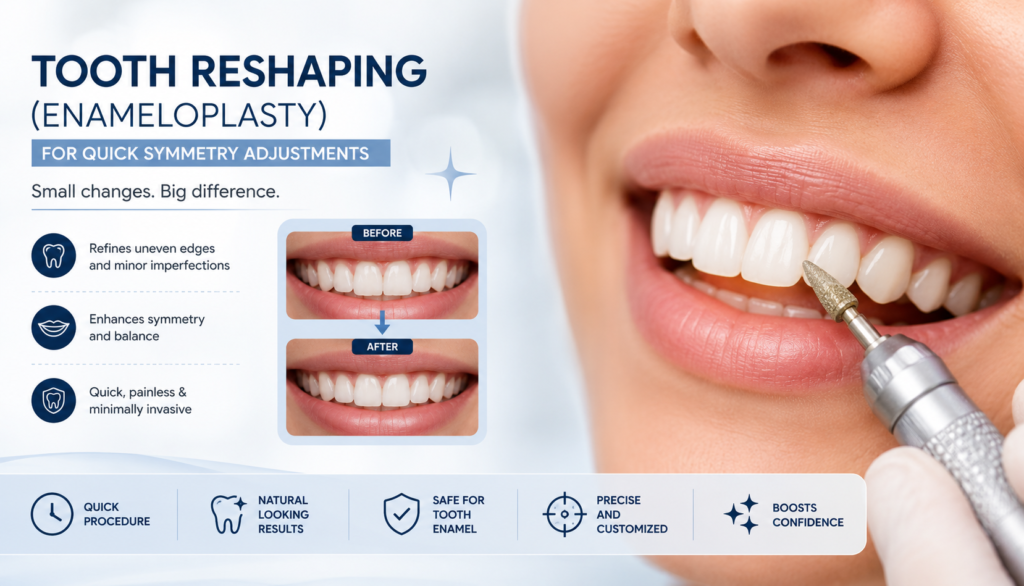
Enameloplasty—also referred to as tooth recontouring, odontoplasty, or dental slenderizing—is a minimally invasive cosmetic dental procedure in which microscopic amounts of tooth enamel are removed to modify a tooth’s shape, length, or surface appearance.
Because outer tooth enamel contains no nerves, the process is entirely pain-free. Dentists use specialized fine-grit diamond burs or sanding strips to sculpt tiny imperfections, instantly creating a more harmonious smile contour.
Common Aesthetic Concerns Fixed by Tooth Reshaping
Tooth reshaping is ideal for minor cosmetic flaws that disrupt smile symmetry without affecting overall dental function or bite health:
Slightly Uneven Tooth Lengths: Shaving a fraction of a millimeter off a longer central or lateral incisor creates an even horizontal baseline.
Chipped or Rough Edges: Smoothing minor wear-and-tear or small chips from biting hard objects.
Overly Pointed Canines: Softening sharp, dominant canine tips into a gentler, more rounded shape.
Overlapped Edges: Removing slight overlaps at the edges to reduce visual crowding.
Pronounced Mamelons: Smoothing out the subtle bumps (mamelons) often left on the edges of adult front teeth after eruption.
Enameloplasty vs. Other Cosmetic Procedures
| Feature | Enameloplasty | Dental Bonding | Porcelain Veneers |
| Primary Goal | Removes small enamel excess | Adds composite resin | Covers front surface fully |
| Treatment Time | 15–30 minutes (Single visit) | 30–60 minutes per tooth | 2–3 visits over weeks |
| Need for Anesthesia | No | Rarely | Typically yes |
| Permanence | Permanent structural change | Lasts 5–7 years (May chip) | Lasts 10–15+ years |
What to Expect During the Procedure
Your dentist examines your teeth and takes digital X-rays to measure enamel thickness and locate the inner pulp cavity. This step guarantees that reshaping can occur safely without exposing vulnerable underlying dentin.
Using a specialty dental pencil, your dentist marks the exact areas of enamel to be contoured, comparing symmetry across left and right sides.
Using a fine-grit diamond bur or sanding strip, microscopic layers of enamel are gently trimmed away. You will feel mild vibration but zero pain or discomfort.
Core Advantages
Instant Results: You walk out of the clinic with an improved smile in under half an hour.
Non-Invasive: Preserves 99%+ of your natural tooth structure without synthetic material.
Budget-Friendly: One of the most economical cosmetic treatments available.
Improved Oral Health: Removing small overlaps or crevices makes flossing easier, reducing plaque trap zones.
Important Limitations
Irreversible: Removed enamel does not regenerate.
Enamel Limits: Cannot correct major misalignment, large gaps, or severe crowding.
Sensitivity Risks: Excess removal can lead to temporary or permanent temperature sensitivity if dentin is approached
Ideal Candidates for Tooth Reshaping
You are an excellent candidate for enameloplasty if you have healthy teeth and gums, adequate enamel depth, and minor cosmetic defects confined to the outer enamel. If your goals require changing tooth color or closing wide gaps, combining enameloplasty with dental bonding or teeth whitening yields a full smile refresh without the high cost of full coverage veneers.