
What is Biomimetic Dentistry?
The word biomimetic literally means “to mimic life.” In dental practice, biomimetic dentistry is an evidence-based approach that seeks to restore damaged, decayed, or fractured teeth in a way that mimics their natural strength, flexibility, function, and appearance.
Rather than relying on mechanical retention—such as grinding down a tooth so a rigid porcelain cap can sit on top—biomimetic dentists use advanced adhesive techniques to bond bio-compatible materials directly to the remaining healthy tissue.
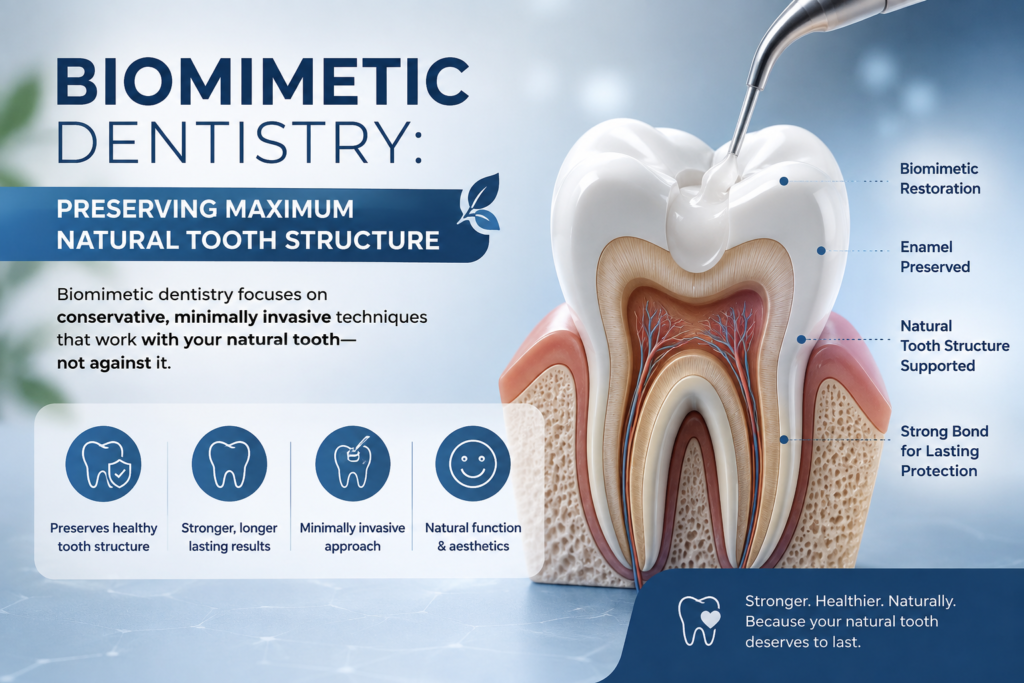
To understand why this approach is so effective, it helps to look at natural tooth anatomy:
Enamel: The hard outer shell of the tooth, designed to resist abrasion and absorb heavy biting forces.
Dentin: The flexible, cushioned layer beneath the enamel that absorbs shock and prevents the tooth from cracking under pressure.
Pulp: The innermost chamber containing nerves and blood vessels that keep the tooth alive and vital.
Traditional crowns treat these distinct layers as a single unit to be shaved down. Biomimetic dentistry respects the unique properties of enamel and dentin, replacing lost tissue layer-by-layer with materials engineered to match their specific strength and elasticity.
1. Maximum Preservation of Healthy Structure
Every millimeter of natural enamel and dentin matters. Biomimetic protocols dictate that dentists remove only decayed or compromised tissue, leaving healthy tooth structure intact. Because the restoration relies on chemical bonding rather than mechanical retention shapes, there is no need to aggressively drill healthy enamel to fit a prefabricated crown.
2. Preservation of Tooth Vitality
One of the most significant drawbacks of traditional crown preparations is the trauma inflicted on the living dental pulp. Aggressive drilling can cause irreversible inflammation, frequently leading to painful root canals. By eliminating unnecessary drilling, biomimetic techniques reduce root canal rates by 80% to 90% compared to traditional methods.
3. Stress-Reduced Direct and Indirect Restorations
When dental composites shrink during light-curing, they pull away from the tooth walls, creating micro-gaps that allow bacteria in. Biomimetic dentists use specialized stress-reducing techniques—such as applying composite in ultra-thin increments and incorporating fiber-reinforcing ribbons (like Ribbond)—to absorb stress and prevent micro-fractures.
4. Long-Term Adhesion and Hybrid Layer Optimization
Biomimetic dentistry relies on creating a “hybrid layer”—a microscopic bond between synthetic resins and the natural collagen fibers within dentin. By using advanced adhesive gold standards (such as immediate dentin sealing), dentists create a seal so strong that it effectively fuses the restoration to the tooth, mimicking the natural dentin-enamel junction (DEJ).
Biomimetic Dentistry vs. Traditional Dentistry: A Direct Comparison
| Feature | Traditional Dentistry | Biomimetic Dentistry |
| Tooth Preparation | Removes 60%–75% of healthy tissue for crowns | Removes only decayed or damaged tissue |
| Retention Method | Friction, geometric shape, and traditional cement | High-strength chemical bonding |
| Pulp Impact | High risk of pulp trauma leading to root canals | Minimal pulp disturbance, preserving nerve vitality |
| Failure Mode | Catastrophic fractures beneath rigid crowns | Repairable, surface-level wear |
| Crack Management | Often covered with a crown, allowing cracks to propagate | Cracks are isolated, sealed, and structurally reinforced |
| Long-Term Economics | Cycle of re-treatment, root canals, and implants | Longer-lasting restorations with easier maintenance |
Key Benefits for Patients
Dramatically Lower Root Canal Rates: Keeping the dental pulp alive saves you from costly, invasive endodontic treatments down the line.
Elimination of Sensitivity: Immediate dentin sealing blocks open dentinal tubules right after preparation, virtually eliminating post-operative temperature sensitivity.
Prevention of Fractures: Traditional rigid crowns can act like a wedge, eventually causing deep root fractures that require tooth extraction. Biomimetic restorations flex naturally with the tooth under biting pressure, distributing stress evenly.
Repairability: If a traditional crown breaks, the entire unit usually needs to be removed and remade. If a biomimetic restoration chips over time, it can simply be bonded and repaired directly in the mouth without removing additional tooth structure.
The Lifecycle of a Tooth: Stopping the "Restorative Spiral"
Dental professionals often talk about the restorative spiral—a sequence where a simple cavity eventually leads to the loss of a tooth:
A small cavity leads to a basic filling.
The filling fails or recurrent decay forms, requiring a larger filling.
The tooth cracks under stress, necessitating a full-coverage crown.
Crown preparation stresses the pulp, requiring a root canal.
The root-canal-treated tooth weakens, breaks at the gum line, and is extracted.
The missing space requires a dental implant or bridge.
Biomimetic dentistry breaks this destructive cycle at step 2 or 3. By sealing cracks early, preserving tooth flexural strength, and avoiding aggressive crown preparations, the natural tooth remains intact, healthy, and functional for decades longer
Is Biomimetic Dentistry Right for You?
Biomimetic principles can be applied to almost any restorative procedure, including:
Treating New Cavities: Using stress-free composite layering instead of traditional deep fillings.
Replacing Amalgam or Failed Fillings: Carefully removing old metal restorations, sealing exposed dentin, and restoring structural integrity.
Addressing Cracked Tooth Syndrome: Bonding fractured segments together rather than grinding the tooth down for a crown.
Inlays and Onlays (Partial Crowns): Replacing only the missing cusps of a tooth while leaving the healthy natural walls untouched.
While biomimetic dentistry requires more precise techniques, specialized training, and additional time in the dental chair, the investment pays off in preserved natural tooth structure and long-term oral health. By mimicking nature’s original design, biomimetic dentistry helps you keep your natural smile intact for a lifetime.