
The quest for a brighter, healthier smile is most effective when cosmetic brightening and structural care work in harmony. Modern oral care balances the removal of stubborn surface and intrinsic stains—using precise oxidizing agents like hydrogen peroxide, carbamide peroxide, or gentler alternatives like PAP—with continuous enamel reinforcement. Because the bleaching process temporarily opens enamel pores and can lead to sensitivity or minor mineral loss, pairing whitening treatments with remineralization agents like nano-hydroxyapatite, fluoride, and amorphous calcium phosphate is vital. These compounds repair microscopic surface defects, seal sensitive dentinal tubules, and rebuild the protective crystalline lattice of the teeth. By combining gentle, non-abrasive stain removal with proactive mineral restoration, you can achieve a luminous, white smile while preserving long-term enamel strength and overall oral health.
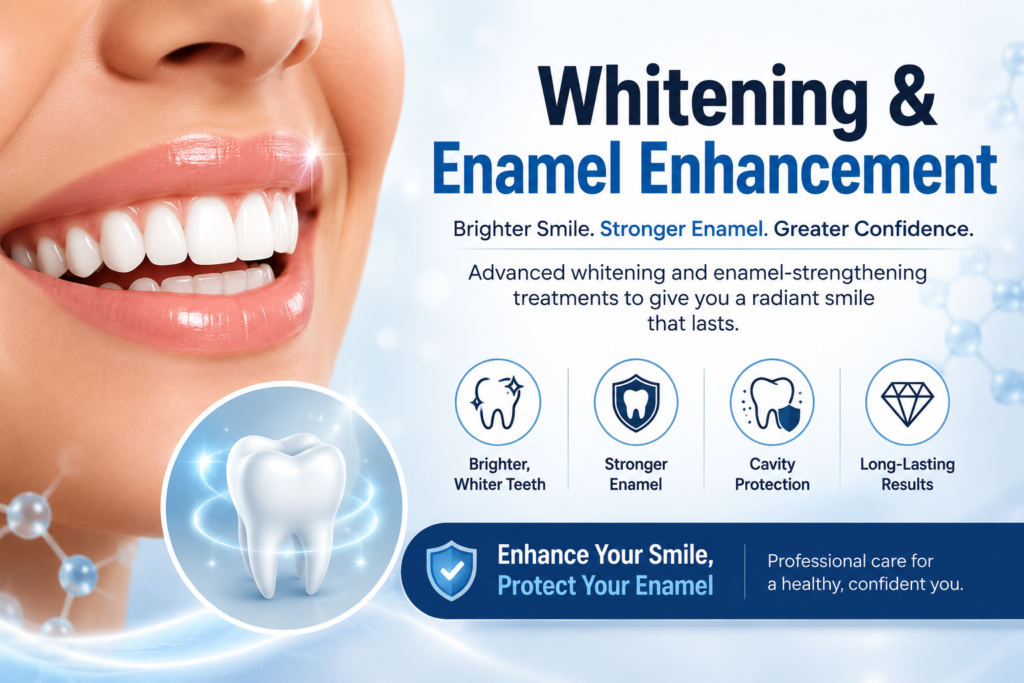
Achieving a radiant smile without compromising structural oral health requires a delicate balance between cosmetic whitening and enamel remineralization. The desire for a brighter smile often leads individuals toward strong bleaching agents, yet the foundation of a healthy, luminous smile lies within the integrity of the enamel—the mineralized outer layer of the teeth.
Understanding Tooth Discoloration and Enamel Structure
To understand how whitening works, it is essential to distinguish between the two primary types of discoloration:
Extrinsic Stains: Caused by daily exposure to chromogens found in coffee, red wine, tea, berries, and tobacco. These pigments bind to the pellicle—the protein film on the tooth surface—and accumulate over time.
Intrinsic Stains: Occur deeper within the dentin matrix due to aging, genetics, trauma, or exposure to certain medications (such as tetracycline) during tooth development. As enamel naturally thins over time, the yellowish color of the underlying dentin becomes more visible.
Enamel itself is composed of roughly 96% hydroxyapatite ($\text{Ca}_{10}(\text{PO}_4)_6(\text{OH})_2$), an inorganic crystalline lattice of calcium and phosphate. While enamel is the hardest substance in the human body, it lacks living cells, meaning it cannot regenerate organically once lost. Therefore, cosmetic treatments must target stain removal while simultaneously protecting and restoring this mineral matrix.
Extrinsic Staining Intrinsic Staining
(Coffee, Tea, Tobacco, Food) (Dentin Thinning, Genetics, Aging)
│ │
▼ ▼
Surface Pellicle Accumulation Deep Dentin Matrix Discoloration
│ │
└───────────────┬──────────────────────────┘
│
▼
Requires Dual Action:
[Whitening Agents] + [Enamel Remineralization]
Active Agents in Modern Whitening Solutions
Effective whitening relies on chemical reactions that break down stain molecules into colorless compounds. The choice of whitening agent determines both the speed of results and the impact on enamel sensitivity:
1. Hydrogen Peroxide ($\text{H}_2\text{O}_2$) & Carbamide Peroxide
Mechanism: Hydrogen peroxide acts as a potent oxidizing agent. It penetrates the porous structure of enamel to break double bonds in organic chromogens, breaking large pigment molecules into smaller, uncolored compounds.
Carbamide Peroxide: Breaks down into hydrogen peroxide and urea upon contact with water (at roughly a 1:3 ratio). It releases peroxides more slowly, making it ideal for overnight or extended-wear tray systems.
2. Phthalimidoperoxycaproic Acid (PAP)
Mechanism: A synthetic organic peroxy acid used as a non-peroxide alternative. PAP oxidizes stains without producing free radicals, significantly reducing the likelihood of nerve irritation or enamel demineralization.
PAP+ Enhancements: Modern formulations combine PAP with potassium citrate and hydroxyapatite to soothe nerve sensitivity and reinforce the mineral structure during whitening.
3. Physical & Enzymatic Polishers
Enzymes: Bromelain (from pineapple) and papain (from papaya) gently dissolve the protein pellicle to prevent stain adhesion without abrasive scrubbing.
Mild Abrasives: Hydrated silica and calcium carbonate physically scrub away surface stains, provided their Relative Dentin Abrasivity (RDA) score remains below 70 to prevent micro-abrasions.
The Role of Enamel Enhancement and Remineralization
Bleaching can temporarily open enamel pores, potentially causing transient sensitivity and temporary mineral loss. Enamel enhancement protocols focus on replenishing minerals, sealing dentinal tubules, and smoothing the surface to reflect light more evenly.
| Remineralizing Agent | Chemical/Mineral Form | Primary Mechanism |
| Nano-Hydroxyapatite (nHAp) | Synthetic Hydroxyapatite nanoparticles | Fills microscopic surface defects, binds directly to natural enamel, and seals exposed dentinal tubules to eliminate sensitivity. |
| Fluoride | Sodium Fluoride ($\text{NaF}$), Stannous Fluoride ($\text{SnF}_2$) | Converts hydroxyapatite into fluorapatite ($\text{Ca}_{10}(\text{PO}_4)_6\text{F}_2$), which is significantly more resistant to acid erosion ($\text{pH} < 4.5$). |
| Amorphous Calcium Phosphate (ACP/CPP-ACP) | Casein Phosphopeptide | Delivers bioavailable calcium and phosphate ions to subsurface enamel lesions, promoting natural remineralization. |
Best Practices for Safe Whitening & Long-Term Maintenance
To achieve bright results while safeguarding enamel health, incorporate these practices into a balanced daily oral hygiene routine:
Pre-Condition Enamel: Use a nano-hydroxyapatite or fluoride-rich toothpaste for 1–2 weeks prior to initiating active bleaching treatments to strengthen the mineral barrier.
Avoid Abrasive Whitening Charcoal Powders: Activated charcoal and high-RDA whitening toothpastes can strip away enamel over time, exposing the darker dentin beneath and worsening long-term discoloration.
Observe the “Dietary White Window”: For 48 hours following peroxide treatments, avoid highly pigmented foods and beverages (coffee, soy sauce, red wine), as enamel pores remain temporarily permeable.
Buffer Acidic Content: Wait at least 30 minutes after consuming acidic foods (citrus, soda) before brushing to prevent brushing away softened enamel.
Pair Whitening with Desensitizing Treatments: Combine whitening gels with active potassium nitrate (which calms nerve pathways) or CPP-ACP to maintain comfort and enamel hardness.
Conclusion
In conclusion, achieving a radiant smile should never come at the expense of dental integrity. True cosmetic success lies at the intersection of effective stain removal and robust enamel enhancement. By prioritizing gentle, non-abrasive whitening methods alongside restorative remineralizing agents like nano-hydroxyapatite and fluoride, you can safely elevate your smile’s aesthetics while fortifying your teeth against daily wear, acid erosion, and sensitivity. A bright smile is a wonderful asset, but a strong, well-protected smile is the ultimate foundation for lifelong oral health.