
Beyond Straight Teeth: The Science of Orthodontic & Structural Aesthetics
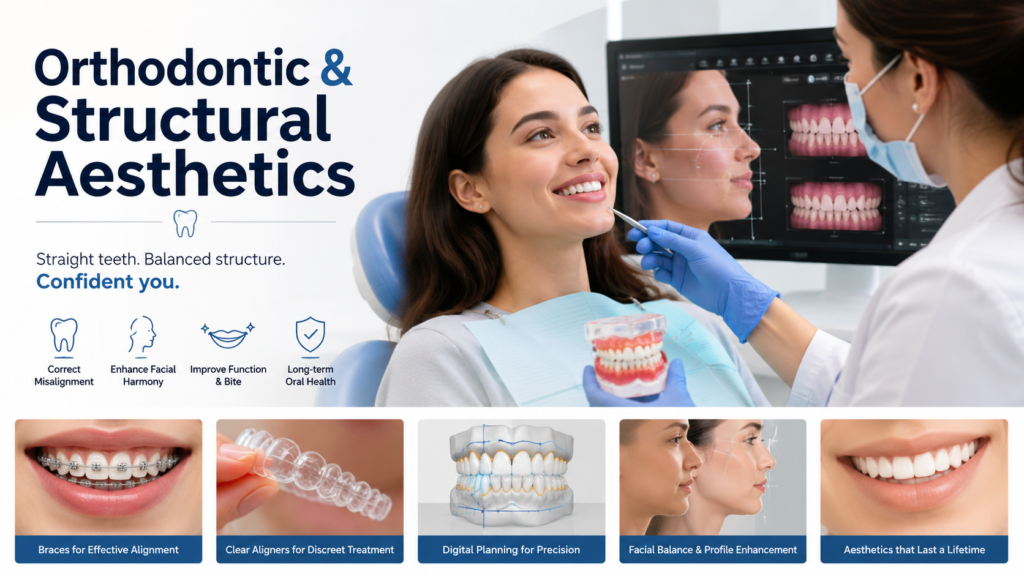
Orthodontic & Structural Aesthetics represents a modern shift in dentistry from simply straightening crooked teeth to optimizing the underlying architecture of the entire lower face. Rather than viewing teeth in isolation, this approach analyzes how the positioning of the upper and lower jaws supports facial soft tissue—including lip fullness, cheekbone projection, jawline definition, and the broadness of the smile arc. By expanding narrow arches and properly positioning the jaw structures, structural orthodontics creates balanced facial proportions and supports long-term facial symmetry while preventing a sunken, premature aging look.
When most people think of orthodontics, they picture teenage years, metal brackets, and one single goal: straightening crooked teeth.
While a neat, aligned row of teeth is certainly a welcome outcome, modern orthodontics has evolved far beyond basic tooth movement. Today, leading practitioners approach orthodontic care through the lens of Structural Aesthetics—a holistic discipline that sits at the intersection of dentistry, facial architecture, and airway health.
What is Structural Aesthetics in Orthodontics?
Structural Aesthetics focuses on how the underlying bone structure of the maxilla (upper jaw) and mandible (lower jaw) supports the soft tissues of the face (lips, cheeks, chin, and neck profile).
Rather than treating teeth in isolation, structural orthodontics looks at:
Facial Proportions: The vertical and horizontal balance of the upper, middle, and lower thirds of the face.
Airway Architecture: How jaw position impacts breathing pathways and nasal posture.
Soft-Tissue Support: How jaw width and projection support the lips and cheeks to prevent premature sagging as you age.
The “Smile Arc”: How the curve of the upper teeth aligns with the natural curvature of the lower lip.
3 Core Principles of Structural Orthodontics
+———————————–+
| FACIAL STRUCTURAL HARMONY |
+———————————–+
|
+——————————-+——————————-+
| | |
v v v
+——————+ +——————-+ +——————-+
| 1. Midface | | 2. Lower Jaw | | 3. Dental Arch |
| Projection | | Profile | | Width |
| (Maxillary Support)| | (Mandibular Line) | | (Buccal Corridors)|
+——————+ +——————-+ +——————-+
1. Midface Support & Maxillary Projection
The maxilla forms the foundation of your midface. When the maxilla is narrow or retruded (set too far back), it can lead to flat cheekbones, deep smile lines (nasolabial folds), and sunken lip support.
By expanding or repositioning the maxilla early in development—or utilizing modern surgical/skeletal expansion in adults—orthodontists create a broader foundation that fills out the cheek corridors and lifts the midface naturally.
2. Jawline & Profile Definition
A recessed lower jaw (mandible) doesn’t just affect your bite—it softens the jawline, creates the illusion of a double chin, and often compromises airway space during sleep.
Aligning the bite structurally elevates the chin position, sharpens the jawline profile, and improves overall facial symmetry.
3. Broad Dental Arches & Eliminating "Dark Corridors"
When you smile, are there empty dark spaces between the corners of your mouth and your teeth? These are known as buccal corridors.
A narrow orthodontic treatment plan might straighten teeth by tipping them inward or extracting teeth to make room. Structural aesthetics, by contrast, focuses on arch expansion, widening the smile so teeth comfortably fill the mouth, producing a vibrant, full “wide-arch” smile.
Traditional vs. Structural Orthodontics
| Feature | Traditional Orthodontics | Structural & Aesthetic Orthodontics |
| Primary Goal | Aligning crooked teeth & fixing occlusion | Optimizing facial harmony, airway, & teeth |
| Space Management | Often relies on tooth extraction | Prioritizes arch expansion & bone development |
| Facial Impact | Focuses strictly on the mouth | Enhances cheekbones, jawline, & lip support |
| Airway Consideration | Minimal | High (helps prevent sleep-disordered breathing) |
| Long-Term Aging | May narrow facial profile over time | Preserves volume for a youthful facial structure |
Modern Innovations Driving Structural Transformation
Achieving true structural aesthetics requires precise diagnostic tools and advanced technology:
3D CBCT Imaging (Cone Beam CT): Allows orthodontists to evaluate airway dimensions, bone thickness, and joint health in three dimensions before moving a single tooth.
Skeletal Expansion (MSE / MARPE): Bone-borne expanders allow adults to achieve true palatal expansion without traditional invasive surgery.
Digital Smile Design (DSD): Customizes bracket placement and clear aligner software using facial proportions as the primary blueprint.
The Verdict: Health Meets Artistry
A great smile isn’t just about perfectly straight teeth; it’s about how those teeth support your entire face. By viewing orthodontic care as facial architecture, Structural Aesthetics delivers results that are not only functionally healthy, but naturally harmonious and age-defying.
If you are considering orthodontic treatment, ask your provider how their proposed plan will impact your overall facial profile, airway, and midface support over time.
Conclusion
Ultimately, Orthodontic & Structural Aesthetics marks a fundamental shift in modern dentistry—moving from simple tooth alignment to comprehensive facial architecture. By focusing on the structural foundation of the jaws, midface support, and airway integrity, this approach ensures that a straight smile works in perfect harmony with your natural facial features. The end result goes far beyond neat rows of teeth: it delivers a full, radiant smile, improved facial balance, and lasting structural support that keeps your feature profile youthful and balanced for years to come.