
The Ultimate Guide to Restoring Your Smile's Function, Health, and Aesthetics
Your smile is often the first thing people notice, but teeth do much more than look good. They allow you to chew your food properly, speak clearly, and support the structural integrity of your face. When multiple teeth are compromised, worn down, missing, or damaged by disease, a simple filling or crown won’t cut it. You need a comprehensive, coordinated approach: Full-Mouth Rehabilitation.
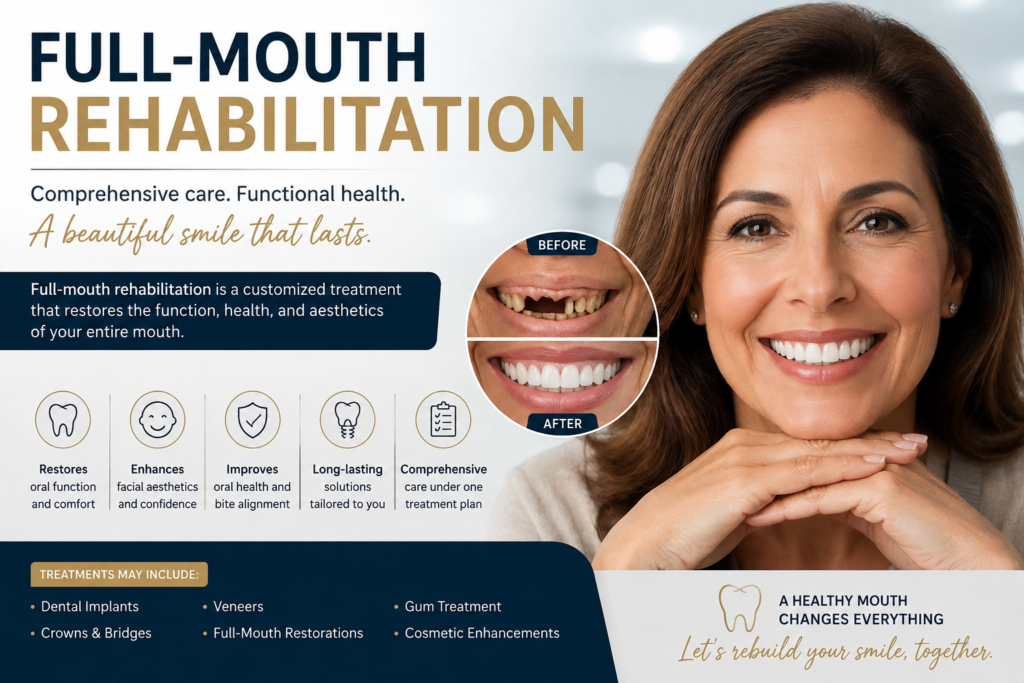
Full-mouth rehabilitation (also known as full-mouth reconstruction) is a transformative dental discipline that combines the art of cosmetic dentistry with the science of restorative and neuromuscular dentistry. If you are struggling with chronic dental pain, worn-down teeth, missing teeth, or bite issues, understanding this procedure can be the first step toward reclaiming your quality of life.
What is Full-Mouth Rehabilitation?
Full-mouth rehabilitation involves rebuilding or restoring all or nearly all of the teeth in both the upper and lower jaws. While cosmetic dentistry focuses primarily on the appearance of your teeth, a full-mouth rehabilitation addresses both aesthetics and function.
The process is customized for every patient. It is not a single procedure, but rather a carefully sequenced master plan combining various restorative and surgical treatments. The primary goals are to eliminate oral pain, restore proper chewing mechanics, treat underlying gum and bone diseases, and create a harmonious, natural-looking smile.
The Difference Between Smile Makeovers and Full-Mouth Rehabilitation
Smile Makeover: Primarily elective and cosmetic. It focuses on improving the visual appearance of teeth that are generally healthy using treatments like teeth whitening, veneers, and minor bonding.
Full-Mouth Rehabilitation: Medically necessary and comprehensive. It treats complex functional problems involving worn-down enamel, missing teeth, bite (occlusion) disorders, temporomandibular joint (TMJ) dysfunction, and structural decay.
Common Signs You May Need Full-Mouth Rehabilitation
Most candidates for full-mouth rehabilitation do not experience just one isolated dental issue. Instead, they suffer from a cascading set of problems that have worsened over time. You may be a candidate if you experience several of the following:
Severe Tooth Wear: Years of teeth grinding (bruxism), acid erosion, or improper bite alignment can wear teeth down to tiny stubs, exposing dentin and causing sensitivity.
Multiple Missing Teeth: Gaps from missing teeth cause surrounding teeth to drift, leading to bite collapse and an uneven distribution of chewing forces.
Chronic Jaw Pain or TMJ Disorders: Discomfort, popping, or clicking in the jaw joints, often accompanied by chronic headaches, neck aches, or muscle fatigue.
Advanced Gum Disease (Periodontitis): Deep pockets, receding gums, and bone loss that threaten the structural foundation of your teeth.
Widespread Decay or Fractures: Multiple broken, cracked, or severely decayed teeth that cannot be managed with standard fillings.
Congenital Conditions: Genetic disorders like Ectodermal Dysplasia or Amelogenesis Imperfecta that result in abnormal tooth development.
The Comprehensive Diagnostic Process
A successful full-mouth rehabilitation requires meticulous planning. Because it involves reshaping your entire bite and restoring structural harmony, your dentist or prosthodontist will perform a thorough evaluation before any treatment begins.
1. Clinical Examination
Your dentist examines your teeth, gums, jaw joints (TMJ), and the surrounding facial muscles. They will check for signs of decay, periodontal disease, tooth mobility, and bite misalignment.
2. Advanced Imaging and Diagnostics
Digital X-rays and 3D CBCT Scans: Provide detailed views of tooth roots, bone density, and jaw structures.
Digital Scans and Physical Impressions: Create accurate 3D models of your teeth to study your bite from every angle.
Photographic Analysis: Facial and intraoral photographs help evaluate how your new teeth will complement your facial features, lip line, and smile arc.
3. Bite (Occlusion) Analysis
Understanding how your upper and lower teeth meet is critical. If your bite is collapsed, your dentist must determine the ideal vertical dimension of your face—the precise distance between your nose and chin when your jaw is at rest—to ensure your new restorations look natural and feel comfortable.
Common Treatments Involved in Full-Mouth Rehabilitation
Because every patient’s mouth is unique, a full-mouth rehabilitation plan is entirely bespoke. Your customized roadmap may include a combination of the following restorative disciplines:
1. Periodontal Therapy
Before building a house, you must ensure the foundation is secure. If you have gum disease, treatments like scaling and root planing, pocket reduction surgery, or bone grafting are performed first to establish healthy gums and stable bone.
2. Dental Implants
The gold standard for replacing missing teeth. Small titanium or zirconia posts are surgically placed into the jawbone to act as artificial roots, supporting crowns, bridges, or full-arch restorations like All-on-4.
3. Crowns and Bridges
Dental crowns (caps) cover severely damaged or worn teeth to restore their strength, shape, and size. Fixed bridges can span gaps left by one or more missing teeth by anchoring to adjacent natural teeth or implants.
4. Porcelain Veneers
Thin, custom-made shells of tooth-colored porcelain bonded to the front surfaces of teeth to improve shape, color, and alignment while preserving underlying tooth structure.
5. Inlays and Onlays
Indirect fillings (sometimes called partial crowns) used when decay or damage is too extensive for a standard filling but does not require a full crown.
6. Orthodontics
In some complex cases, braces or clear aligners are used to reposition teeth into their correct alignment before restorative work begins, reducing the need for aggressive tooth reduction.
Step-by-Step What to Expect During the Journey
Undergoing full-mouth rehabilitation is a journey that requires patience, commitment, and close collaboration with your dental team. Here is what the typical timeline looks like:
Phase 1: Consultation and Diagnosis: Comprehensive scanning, treatment planning, and discussing financial and scheduling options.
Phase 2: Foundation and Preparatory Work: Treating active gum disease, performing extractions of non-salvageable teeth, executing root canal treatments, and placing bone grafts or dental implants as needed.
Phase 3: Temporary Restorations: While permanent restorations are crafted in a specialized dental laboratory, you will be fitted with provisional (temporary) crowns or bridges. This crucial trial period allows you to test out your new bite, phonetics, and aesthetics, and gives your jaw muscles time to adapt.
Phase 4: Permanent Restoration Placement: Once you and your dentist are completely satisfied with the fit, function, and look of the temporaries, your custom permanent restorations are bonded or cemented into place.
Phase 5: Maintenance and Aftercare: Regular follow-up visits, professional cleanings, and wearing a custom night guard (if you grind your teeth) to protect your investment.
The Life-Changing Benefits of Full-Mouth Rehabilitation
Investing time and resources into a full-mouth rehabilitation yields profound benefits that extend far beyond your physical appearance:
Restored Functionality: You will be able to chew your food comfortably again, expanding your diet and improving overall nutrition and digestion.
Pain Relief: Eliminating bite imbalances and temporomandibular joint stress relieves chronic headaches, jaw aches, and facial tension.
Enhanced Confidence: A radiant, complete smile boosts self-esteem, allowing you to laugh, speak, and socialize without hesitation.
Long-Term Oral Health: Replacing failing restorations and treating gum disease stops the cycle of progressive dental decay and tooth loss.
Facial Rejuvenation: Collapsed bites can cause the lower third of the face to sag, creating a prematurely aged appearance. Restoring your bite height naturally supports facial muscles, smoothing fine lines around the mouth.
Caring for Your Restored Smile
Your new smile is engineered for durability, but it requires diligent daily maintenance to last a lifetime. Protect your rehabilitation investment with these best practices:
Meticulous Oral Hygiene: Brush twice a day with a non-abrasive fluoride toothpaste and floss daily. If you have dental implants or bridges, use interdental brushes or a water flosser to clean hard-to-reach areas.
Wear Your Night Guard: If bruxism (teeth grinding) caused your original tooth wear, wearing a custom occlusive night guard while sleeping is mandatory to protect your new porcelain and composite restorations.
Routine Dental Check-ups: Visit your dentist every 3 to 6 months for professional cleanings, bite checks, and early detection of potential issues.
Avoid Damaging Habits: Refrain from chewing ice, opening packages with your teeth, or biting hard objects that could chip or fracture your restorations.
Conclusion
Full-mouth rehabilitation is more than a dental procedure—it is a life-altering medical intervention that restores health, confidence, and comfort. If years of wear, missing teeth, or chronic pain have taken a toll on your oral health, modern dentistry offers advanced, predictable solutions.
Consult with an experienced restorative dentist or prosthodontist today to explore a customized treatment plan. Taking that first step opens the door to a healthier, pain-free, and beautiful smile that will serve you for decades to come.