
When it comes to enhancing your smile, modern cosmetic dentistry offers more high-quality options than ever before. If you are dealing with gaps, chipped edges, uneven shapes, or stubborn discoloration, three primary treatment methods dominate the conversation: traditional composite bonding, the Bioclear method, and porcelain veneers.
While all three options can deliver dramatic, confidence-boosting results, they differ significantly in their materials, longevity, preservation of natural enamel, cost, and overall procedure. Choosing the right path depends on your unique dental goals, budget, and preference for tooth preservation.
Below is a detailed guide comparing Bioclear, composite bonding, and porcelain veneers to help you decide which smile restoration method is best for you.
1. Traditional Composite Bonding: The Quick, Conservative Touch-Up
How the Procedure Works
Preparation: Minimal prep is required. Your dentist lightly roughens the tooth surface and applies a conditioning gel to help the material adhere.
Application: The dentist applies the pliable composite resin in layers, carefully sculpting it by hand to correct shape, width, or length.
Curing & Polishing: A high-intensity curing light hardens the resin in seconds. Finally, the dentist smooths and polishes the restoration to match the sheen of your natural teeth.
Key Advantages
Ultra-Conservative: Requires little to no removal of natural enamel, keeping the natural tooth structure intact.
Single-Visit Treatment: The entire process takes between 30 to 60 minutes per tooth, delivering immediate results.
Cost-Effective: It is the most affordable initial investment among cosmetic restorations.
Easy to Repair: If the resin chips or wears down over time, it can easily be repaired or refreshed in a single short visit.
Potential Drawbacks
Susceptible to Staining: Composite material is slightly porous compared to porcelain. Over time, exposure to coffee, tea, red wine, and smoking can lead to discoloration.
Shorter Lifespan: Hand-sculpted bonding typically lasts 3 to 7 years before requiring touch-ups or replacement.
Lower Relative Strength: While durable, standard composite is more prone to chipping under high biting pressure compared to porcelain or injection-molded resin.
2. The Bioclear Method: The Modern, Injection-Molded Middle Ground
How the Procedure Works
Biofilm Removal: The dentist cleans the target teeth using a gentle abrasive spray to eliminate bacteria and biofilm, ensuring a strong chemical bond.
Matrix Placement: Flexible, clear anatomical forms (matrices) are slipped around the tooth and tucked slightly beneath the gumline.
Injection Molding: Instead of placing thick resin by hand, warm flowable composite is injected into the clear mold. This encapsulates the entire tooth in a single, seamless shell of high-density material.
Sculpting & High-Glow Polishing: Once cured, the matrices are removed, leaving a continuous, smooth surface that is polished to a mirror-like finish.
Key Advantages
Eliminates Black Triangles: Bioclear is exceptionally effective at closing “black triangles”—dark gaps near the gumline caused by gum recession or bone loss—without irritating soft tissues.
Monolithic Strength: Injection molding creates a unified, void-free layer of composite that is significantly stronger and more fracture-resistant than hand-layered bonding.
Enamel Preservation: Like traditional bonding, Bioclear requires zero to minimal removal of natural tooth enamel, making it fully reversible in most cases.
High Stain Resistance: Because the material is heated and highly compacted, it achieves a smooth finish that resists stains better than standard bonding.
Longer Lifespan: Bioclear restorations routinely last 10 to 15 years with good oral hygiene.
Potential Drawbacks
Technique Sensitive: Bioclear requires specialized dentist training and precise isolation of the tooth, meaning not every general dentist offers it.
Higher Cost Than Bonding: While less expensive than porcelain, Bioclear costs more than basic hand-sculpted bonding due to the specialized equipment and technique involved.
3. Traditional Porcelain Veneers: The Gold Standard for Full Transformations
Consultation & Design: Your dentist takes digital scans or impressions and collaborates with you to design your desired tooth shape, shade, and overall smile aesthetics.
Enamel Preparation: To ensure the veneers sit flush with your natural gumline, a thin layer of enamel (typically 0.3mm to 0.7mm) is gently shaved off the front of the teeth.
Temporary Veneers: You wear temporary acrylic veneers for 1 to 2 weeks while a master dental ceramist handcrafts your permanent porcelain shells in a laboratory.
Final Bonding: At the second visit, your dentist checks the fit and color before permanently adhering the porcelain shells using high-strength dental cement.
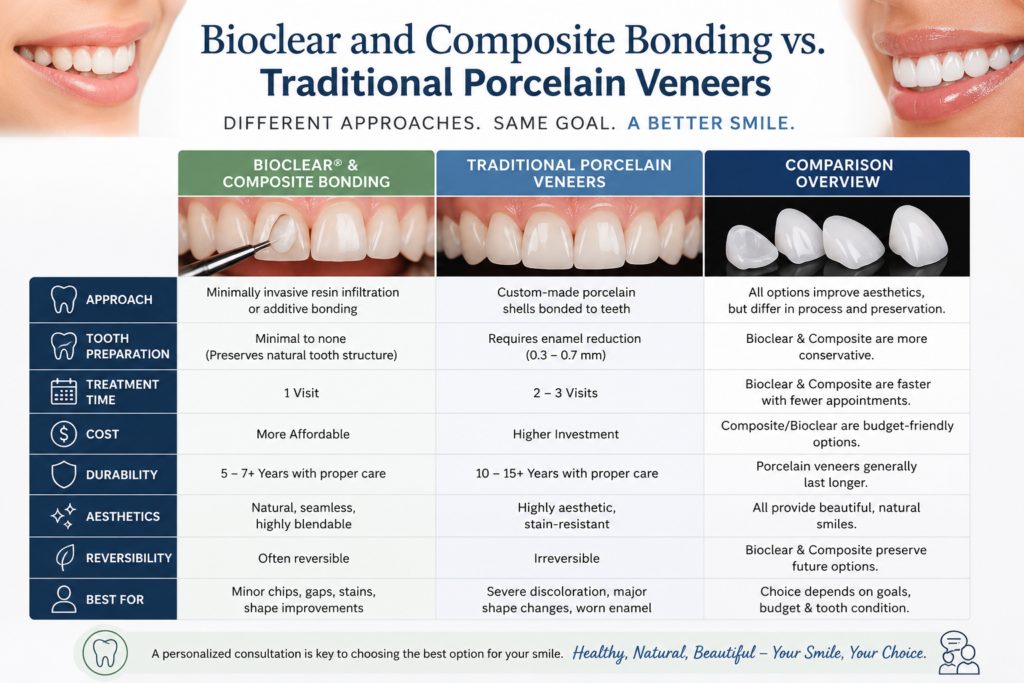
Key Advantages
Unmatched Aesthetics & Translucency: Dental porcelain captures light almost identically to natural enamel, providing a realistic, high-end appearance.
Maximum Stain Resistance: Porcelain is non-porous and virtually impervious to staining from dark liquids, food dyes, and tobacco.
Exceptional Longevity: With proper care and regular checkups, high-quality porcelain veneers last 15 to 20+ years.
Complete Redesign: Porcelain veneers can mask severe intrinsic discoloration, repair heavy wear, and straighten visually misaligned teeth in a way that resin materials cannot always achieve.
Comprehensive Feature Comparison
Feature Traditional Composite Bonding Bioclear Method Porcelain Veneers Material Used Hand-sculpted dental resin Warm injection-molded composite Custom-baked dental ceramic Enamel Reduction None to minimal None to minimal Moderate (0.3mm–0.7mm) Reversibility Fully reversible Fully reversible Irreversible (requires ongoing coverage) Average Lifespan 3–7 years 10–15 years 15–20+ years Stain Resistance Low to Moderate High Maximum Strength & Durability Moderate High Very High
How to Choose the Right Treatment for Your Smile
Choose Composite Bonding if: You need a quick, budget-friendly fix for a single chipped tooth or minor gap, and you want to leave your natural enamel entirely intact.
Choose Bioclear if: You want a long-lasting, stain-resistant solution that can close dark triangles or reshape multiple teeth without permanently altering your natural tooth structure.
Choose Porcelain Veneers if: You are seeking a full smile transformation with maximum stain resistance, unmatched translucency, and long-term durability, and you are comfortable with permanent enamel preparation.
Evaluating your bite structure, habits (such as nighttime teeth grinding), and long-term expectations during a consultation with a cosmetic dentist will help ensure you select the approach that keeps your teeth healthy and functional for years to come.